This is the last post in a four-week series expanding on my review of Stephen Meyer's book Return of the God Hypothesis. Subscribe to get the next series in your inbox!
In my previous posts, I've expressed skepticism about the project of intelligent design (ID). My first two posts didn't attack ID directly. Rather, I suggested that the decline of Christian belief among scientists is as much a problem with Christianity and the church as it is with the scientific community. My third post raised questions about a key assumption of the ID movement. Is a Christian theistic universe more likely to be one in which life is probable or improbable? ID proponents assume that a high probability for the emergence of life is evidence against God. I disagreed.
In this concluding post, I argue against leading with ID when engaging the academy. Although ID seeks acceptance within the halls of the academy, it has been rejected by (almost) all subject-matter experts. This on its own doesn't mean ID is false. But it does mean that one will not gain any traction by appealing to it in defense of Christianity.
What is the best path for Christianity to regain legitimacy in the academy? It's not going to come through financing political campaigns to undercut confidence in science and sway public opinion regarding evolution and ID. As counter-intuitive as it may sound, I suspect the most promising path will instead be through respecting the expertise of subject-matter experts.
While in grad school, I once attended a lecture by a world-renowned physics professor, Jonathan Feng. Feng had been accepted to work under Stephen Hawking while a student at Cambridge. He elected instead to return to the United States to finish his PhD, because of the racism and alienation that he experienced day-to-day in British society.
Feng is a professing Christian – a fellow Presbyterian, I believe. The purpose of the lecture was to tell us about how his values informed his research. Along the way, we also heard about his struggle finding an academic appointment after grad school. At long last, he received an offer from UC Irvine. But after he accepted it, other, objectively better offers started flooding in. When he asked his wife whether he should reconsider committing to UC Irvine, she told him: "Let your yea be yea, and your nay be nay." Here is someone who allowed his Christian ethics to shape his career.
He also spoke about the humility that his dark matter research instilled in him, comparing that to the humility that comes from believing in an omnipotent and omniscient God. And finally, he talked about the motivation that his Christianity gave him to do his research, quoting James Clerk Maxwell. All of this was aimed at showing us that there is no war between science and faith. That a scientist like himself can be a Christian without his head exploding.
During the Q&A time, an audience member pressed him on why he was specifically a Christian, as opposed to some other religion. He could have responded in any number of ways. I'm sure the Christians in the audience were hoping to hear him trot out a sophisticated proof of Christianity. Instead, all he said was this:
There's a whole lot of other things that inform people's choice in religion than just whether the universe was created or not. I would say that if you really want to assess the truth of the Christian gospels, you need to talk to people who aren’t physicists. You need to talk to New Testament scholars. You need to talk to philosophers. You need to talk to others. So, I think I’m going to punt on that one. But I do have reasons [for my Christian belief], and I can direct you to some of the great scholars I’ve read that have informed my thinking on this.
(In conversation afterward, I believe he pointed another interlocutor specifically to N. T. Wright's The Resurrection of the Son of God, which is probably still the most comprehensive and well-respected treatment of the issue.)
 N. T. Wright (Author)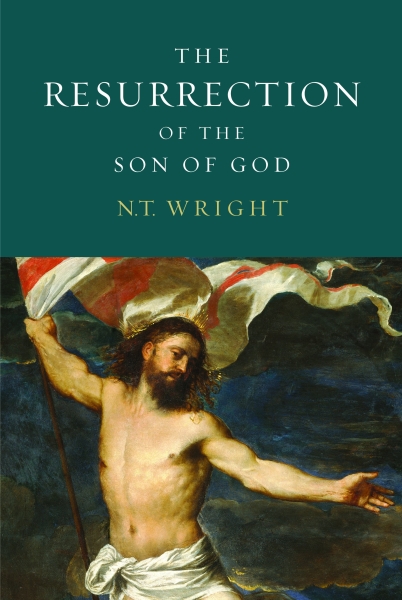
Some readers will think that this was a cop-out. But it reflects the mindset of a true scholar, speaking to other scholars. The resurrection was a real, historical event. And because it was a real, historical event, it is not the sort of thing a physicist is set up to investigate as seriously as a historian or biblical scholar could. Instead, the physicist testifies to the hope that the gospel provided in dark times, the curiosity about the natural world that his Christian theism fueled, and how the ethics of Jesus helped him navigate difficult choices early in his career. Far from hindering his Christian testimony, Feng's intellectual humility and respect for the subject-matter experts only strengthened it.
Of course, that's not the end of the story. The church should respect the expertise of the scientist – so far as that expertise extends. But the scientist should also remember that the church has a legitimate claim to expertise in other areas – theology and biblical studies. This is not to say that secular scholars cannot contribute to these fields at all. But the rest of the intellectual community does need to take the church's voice seriously on these matters. And, the church must live up to this claim of legitimacy by encouraging the careful study of the Scriptures and the natural world within its ranks.
This is the last post in a four-week series expanding on my review of Stephen Meyer's book Return of the God Hypothesis. Subscribe with your email, or follow on Bluesky to get the next post in a convenient place!
 Jack VanDrunen
 Jack VanDrunen
 Jack VanDrunen
 Jack VanDrunen